Many companies bring in an interim manager when they need someone to step in and “take care of things.” That may sound like relief. But someone who only maintains the status quo rarely creates real momentum.
Especially in critical situations, during transformations or strategic shifts, the task is not routine. It is leadership, direction and responsibility.
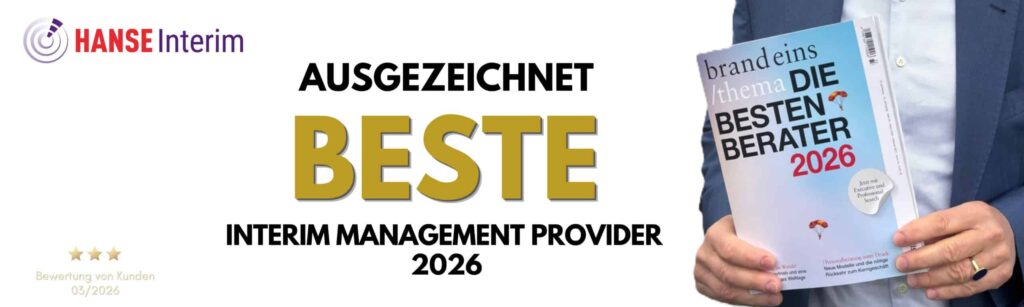
Finding the right solution for each company, especially in challenging situations, is exactly what we aim for at HANSE Interim. We are therefore pleased that brand eins has recognized HANSE Interim in 2026 as one of the best interim management providers. The ranking is based on recommendations from clients and industry peers.
For us, this is less about the ranking itself and more about what it represents: effective interim management is about shaping, not simply managing.
Interim management is more than temporary capacity
Interim managers are often perceived as gap fillers.
Someone leaves the company, a project leadership role becomes vacant, a CFO suddenly departs.
The temptation is strong to reduce the role to the essentials: keep processes running, maintain reporting structures and prepare a transition.
But that approach misses a powerful opportunity.
Interim managers bring experience, an outside perspective and the freedom to act. Their independence is often one of their greatest strengths. They are not embedded in internal power structures and they are not pursuing a long-term career within the organization.
This allows them to take decisions others might postpone. They are there to create movement.
For a limited time, but with lasting impact
Der Unterschied liegt in der Haltung
Those who manage ask:
What has been done so far, and how do we keep it stable?
Those who shape ask:
What actually works here? And what does not?
Where is the real lever for change?
Leadership that shapes rarely appears in grand speeches. It appears in daily actions:
- questioning routines
- simplifying processes
- making decisions, even when they are uncomfortable
- bringing teams along instead of just delegating tasks
- setting priorities when everything seems urgent
And above all: communicating clearly.
Interim managers who shape are willing to address issues others may avoid. Respectfully, but directly.
Situations that require real leadership
Profitability crises
An interim CFO who only delivers monthly reporting will fall short of the opportunity.The real impact comes when the CFO works with management to analyze root causes, address pricing issues, improve working capital and drive operational measures.
Not managing, but acting.
Post-merger integration
When two companies come together, it is not enough to draw a new organizational chart. Someone must connect cultures, close operational gaps and align leadership teams around a shared direction.
Digital transformation
An interim IT leader who only maintains existing systems will miss the strategic opportunity.Companies that need to catch up digitally require clear architecture decisions, pragmatic solutions and early involvement of the business units.
Restructuring
Whether as CRO or in another leadership role during a critical phase, managing alone will never be enough. Speed, clarity and the courage to take decisions are essential.
Those who shape
can guide a company through a crisis.
Those who only manage
may simply witness the consequences.
Why the right matching matters
The effectiveness of an interim manager does not depend solely on expertise or experience. What matters most is whether the assignment fits the situation, the leadership environment and the personality involved.
Interim management must become effective quickly. That only works when the task is clearly defined and the person fits the specific situation of the company.
When selecting an interim manager, companies should therefore look beyond the organizational chart. Situational leadership experience, communication skills and the willingness to take responsibility are just as important.
What companies should look for
- clear goal orientation from day one
- willingness to take responsibility
- experience in comparable situations
- strong implementation skills, not just analysis
- credibility with teams and stakeholders
The better these factors match the company’s needs, the greater the impact.
This is why many companies rely on specialized providers such as HANSE Interim when selecting interim managers.
Clear expectations are the starting point
Successful interim assignments begin with a precise briefing.
What should be achieved?
Where does the company need stability?
And where is change required?
The most effective mandates start with a clear understanding of the role and the expectations attached to it.
Clients should not hesitate to set high standards. Interim managers who want to shape outcomes must also be prepared to address difficult issues.
Constructively.
On equal footing.
In the interest of the company.
Conclusion: catalysts, not placeholders
Managing is necessary.
Shaping creates impact.
Companies that only look for someone to maintain the status quo miss a powerful opportunity. Those who enable real leadership gain more than a temporary solution. They create movement.
Interim management works best when both sides truly aim to shape outcomes. Client and manager alike.
Best regards
Andreas Lau and Özlem Parakenings
for HANSE Interim