How a private university achieved a successful turnaround without losing sight of its educational mission.
Restructuring under exceptional circumstances
Restructuring projects usually follow a clear economic rationale. Costs are reduced, processes are streamlined and organisational structures are redesigned. But what happens when financial decisions also affect academic quality, governance, employee participation and the future of 15,000 students?
That was the challenge facing a state-recognised private university in Germany. To successfully lead the restructuring, the university turned to HANSE Interim to fill a critical executive role. HANSE Interim appointed experienced interim executive Susanne Möcks-Carone. She initially assumed the role of General Representative before being appointed Chief Executive Officer, taking full responsibility for the university’s financial stabilisation and restructuring.
The assignment was exceptional. It was not simply about improving financial performance. Every decision had to balance economic requirements with academic standards, accreditation, employee representation, shareholder interests and the university’s educational mission.
Leading through complexity
The financial challenges were only one part of the assignment.
The project required strong leadership in an environment characterised by complex governance structures, active employee representation, political influences and differing shareholder expectations. At the same time, teaching operations and institutional accreditation had to remain fully protected.
A successful turnaround therefore required far more than cost reduction. It demanded transparency, sound decision-making and the ability to build trust across all stakeholder groups.
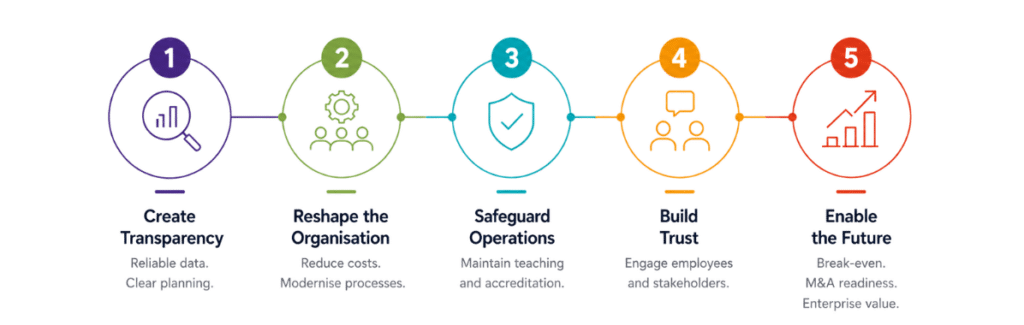
The first step was establishing a reliable data foundation. Based on this, an integrated business plan and a comprehensive restructuring programme were developed to secure both short-term financial recovery and the university’s long-term future.
Driving change without disrupting education
With a clear roadmap in place, the restructuring programme moved into implementation.
Key measures included:
- Consolidating 32 of the university’s 44 study centres across Germany and Austria without disrupting teaching operations.
- Modernising and digitising the academic portfolio.
- Further developing degree programmes and academic concepts.
- Implementing extensive organisational and workforce adjustments in close cooperation with employee representatives.
- Introducing transparent management reporting and more efficient business processes.
One of the project’s greatest achievements was maintaining academic quality throughout the transformation. Student numbers remained stable despite a challenging market environment, while institutional accreditation was successfully secured.
Turnaround of the privat university in 5 Steps
Why trust became the decisive success factor
Turnaround projects are often measured by financial results alone. This assignment demonstrated that sustainable success depends just as much on people.
Building trust among employees, university committees, shareholders and external stakeholders proved essential. Transparent communication, consistent leadership and clearly explained decisions created the foundation for implementing far-reaching changes in a highly sensitive environment.
A turnaround that created long-term value
The restructuring delivered measurable results within just twelve months.
The university reached break-even within the planned timeframe. Financing requirements remained well below the original assumptions, and the organisation was successfully positioned for a structured M&A process. Today, the university once again benefits from sustainable profitability and a solid enterprise value.
So what does it take to successfully turn around a university facing an existential crisis?
Certainly, robust financial planning and decisive restructuring measures. But above all, it requires leadership that provides direction, builds trust and remains effective even under highly complex conditions.
This project demonstrates what interim management can achieve in highly demanding transformation situations. Success is not determined by financial figures alone. It requires the ability to unite people behind a common goal, create trust and deliver sustainable change under challenging conditions
Andreas Lau, Managing Director of HANSE Interim
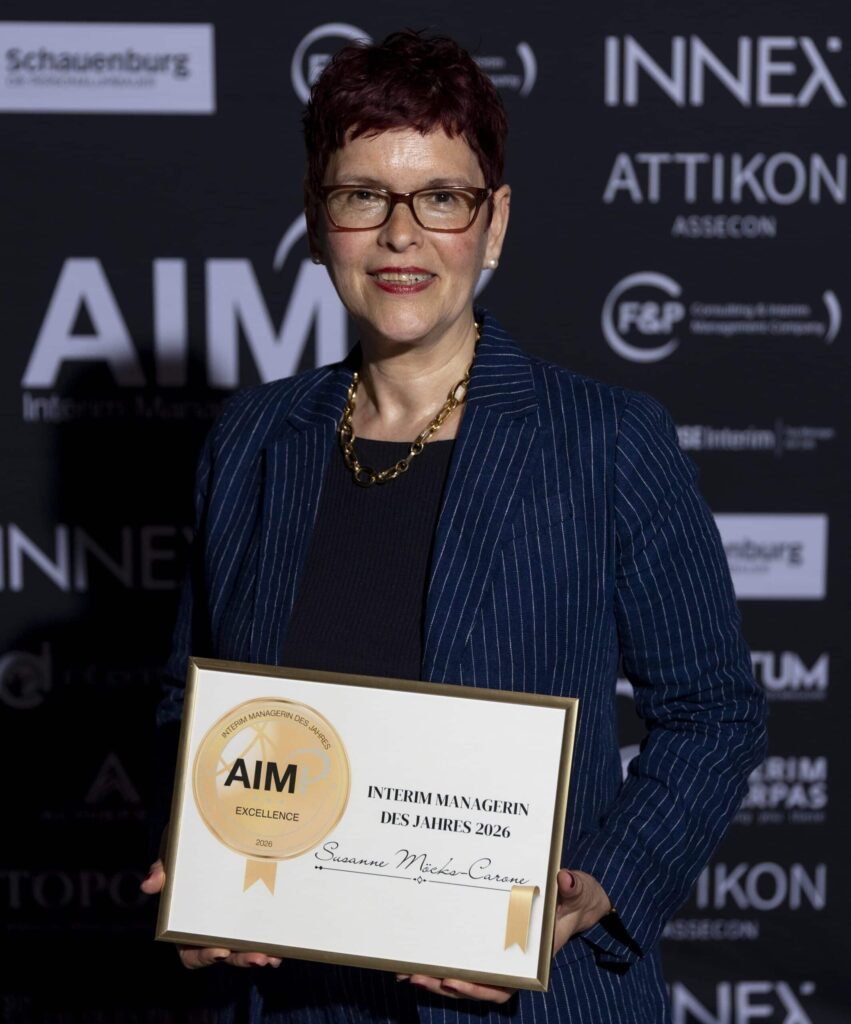
For this outstanding achievement, Susanne Möcks-Carone was named Interim Manager of the Year 2026 by the German Association of Interim Management Providers (AIMP).
The award recognises her exceptional contribution to one of the most complex restructuring projects in the higher education sector.
Best regards
Your HANSE Interim Management
Andreas Lau